How do I troubleshoot & repair common small engine problems?
Mower or snow blower won’t start? Use this Briggs & Stratton small engine repair FAQ for troubleshooting common problems & issues with engines.
4 min read

Is there no spark in the engine of your lawn mower, snow blower or outdoor power equipment? Follow this guide to test your ignition system - including coil, switch & module - to identify any problems and troubleshoot repairs.
If you know your specific problem, jump down to the section for step-by-step instructions.
How Do Ignition Systems Work in Small Engines & Lawn Mowers?
Servicing Spark Plug Problems
How to Test the Ignition Coil in Your Small Engine
Testing & Replacing a Stop Switch
Ignition Module Failure
How To Inspect the Flywheel & Key
WARNING: Always read the engine and equipment manual(s) before starting, operating, or servicing your engine or equipment to avoid personal injury or property damage. See an authorized dealer or contact Briggs & Stratton if you are unsure of any procedure or have additional questions.
Find all Engine Safety Warnings.
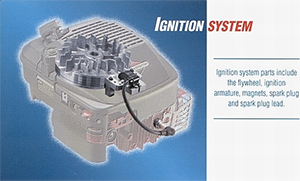
The ignition system is the starting system for your small engine. Whether you start the engine with a pull rope or the turn of a key on an electric start motor, you're relying on the ignition system to produce a spark inside the combustion chamber.
When you start your lawn mower or small engine, you turn the flywheel and its magnets pass the coil (or armature). This creates a spark. The ignition system coordinates the timing so that the spark will ignite the air-fuel mixture in the combustion chamber just as it reaches maximum compression in each engine cycle- thus, maximizing the engine’s power.
Once the engine is running, the flywheel keeps rotating, the magnets keep passing the coil and the spark plug keep firing based on a specific timing.
If you are experiencing ignition timing issues, this is most often due to a sheared flywheel key. You can also test the flywheel magnets for any potential issues.
For information regarding this, please visit our Inspecting the Flywheel and Key FAQ.
Common Spark Plug Problems
Safety Warnings:
Stay clear of any rotating, moving parts, or other hazardous areas whenever attempting to start the engine or equipment.
The coil is probably the easiest thing to check and therefore the first thing to check when embarking upon ignition system troubleshooting.
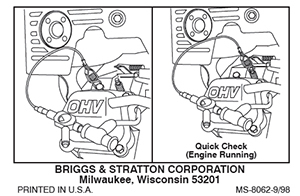
If the spark jumps the tester gap, your ignition coil is working fine. If not, it needs to be replaced.
Engine quits while running? Hook the tester up between the ignition cable and the spark plug and start the engine. When it stops, monitor the window.
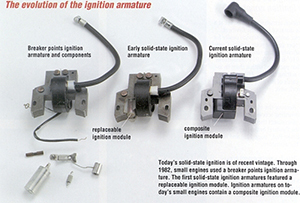
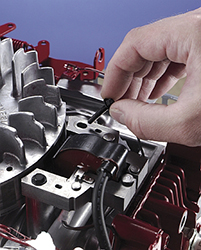
An ignition armature must be set at a precise distance from the flywheel. Your engine repair manual will provide the proper gap for your engine. Common armature gap ranges are .006 - .010" and .010 - .014". Armatures are often packaged with a shim to assist in setting the gap. Index cards of the proper thickness also work well.
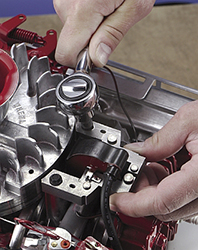
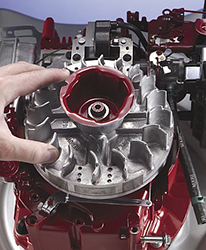
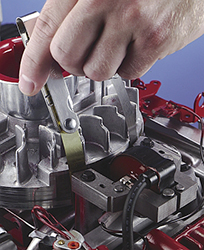
Breaker point ignition systems were common through 1982. You can improve its reliability on a single-cylinder Briggs & Stratton engine equipped with breaker points and a two-leg armature by installing a solid-state ignition conversion kit (service part number 394970) that bypasses the points (conversion kit will not work with a three-legged ignition armature).
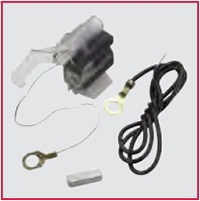
Additional questions? Please consult a Briggs & Stratton Service Dealer for conversion kit and installation.
Safety Warning: Stay clear of any rotating, moving parts, or other hazardous areas whenever attempting to start the engine or equipment.
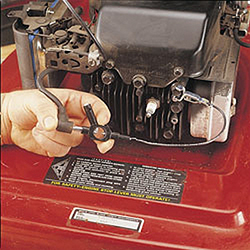
A spark should be visible in the tester. If no spark appears, check for broken wires, shorts, grounds or a defective stop switch.
Once you have confirmed that the stop switch is working, reconnect the spark plug lead.
If your ignition start or push button start needs replacing, consult a Briggs & Stratton dealer near you.
Because the ignition module is electronic and does not utilize moving components, it is normally one of the most reliable part of the engine. When it does fail, it is usually due to heat caused from improper wiring of the ground wire to battery voltage.
If the engine does not produce spark, other areas of the ignition system should be checked before focusing on the ignition module as source of failure (see above).
If no fault is discovered in the above mentioned areas, the ignition module itself may need to be examined. To best determine the cause of failure, please consult an Authorized Dealer.
Mower or snow blower won’t start? Use this Briggs & Stratton small engine repair FAQ for troubleshooting common problems & issues with engines.
Is your small engine starter not engaging? Learn about lawn mower starter problems & motor repair options with this Briggs & Stratton FAQ.
Looking for valve maintenance and repair tips? Follow our step-by-step guide to remove and clean your valves for better engine performance!